

Dementia already costs Australia ~A$18 billion annually, with projections to reach ~A$37 billion per year by 2050 if left unchecked (AIHW: https://www.aihw.gov.au/reports/dementia/dementia-in-aus/contents/health-and-aged-care-expenditure-on-dementia, National Press Club 2025 briefing: https://www.aihw.gov.au/reports/dementia/dementia-in-australia-2023).
Hospital use is significantly higher: dementia patients stay 6× longer in hospital (15.5 days vs 2.7 days) and cost an average A$7,720 per admission vs A$5,010 without dementia (AIHW: https://www.aihw.gov.au/reports/aged-care/dementia-care-in-hospitals-costs-and-strategies/summary).
The average cost of dementia care per person is about A$35,500 per year; in residential care this rises to ~A$88,000 per year (Dementia Australia: https://www.dementia.org.au/sites/default/files/2024-02/The-economic-cost-of-dementia-in-Australia-2016-to-2056.pdf, PMC study: https://pmc.ncbi.nlm.nih.gov/articles/PMC6032872/).
Loneliness compounds decline and costs Australia A$2.7 billion per year, or around A$1,565 extra per older person affected (Medical Journal of Australia: https://www.mja.com.au/journal/2024/221/6/loneliness-epidemic-holistic-view-its-health-and-economic-implications-older-age).
A 5% reduction in new dementia cases through prevention and early detection could save ~A$720 million annually by the mid-2020s and A$17.6 billion over 20 years (Dementia Australia/NATSEM: https://www.dementia.org.au/sites/default/files/2024-02/The-economic-cost-of-dementia-in-Australia-2016-to-2056.pdf).
Every 10,000 people who delay entry to residential care by 2 years equates to A$700 million–A$1.76 billion in avoided costs, depending on whether you use conservative or full-care cost estimates (PMC: https://pmc.ncbi.nlm.nih.gov/articles/PMC6032872/).
By 2050, this same 5% reduction could avoid ~A$53.8 billion in direct dementia costs in Australia (Dementia Australia modelling).
Globally, dementia and Alzheimer’s will cost US$14.5 trillion by 2050. Delaying care by just 2 years could reduce global costs by US$535 billion (5% reach), US$1.1 trillion (10%), or US$2.7 trillion (25%) (World Alzheimer Report: https://www.alzint.org/resource/world-alzheimer-report-2023/, EldrAIr projections: https://www.dementia.org.au/sites/default/files/2024-02/The-economic-cost-of-dementia-in-Australia-2016-to-2056.pdf).
Early detection provides time for families to plan, access treatment, and prepare emotionally, reducing crisis-driven admissions (Columbia AI Research: https://magazine.columbia.edu/article/ai-can-hear-who-getting-dementia).
By preventing avoidable hospitalisations and delaying care entry, patients retain independence longer, and families face fewer sudden care transitions (AIHW: https://www.aihw.gov.au/reports/aged-care/dementia-care-in-hospitals-costs-and-strategies/summary).
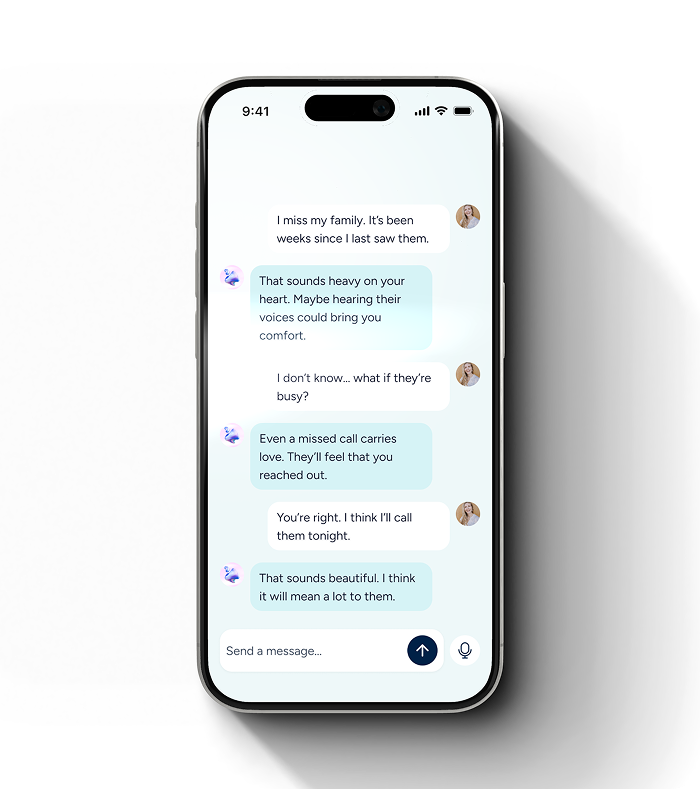
Tackling loneliness through conversational AI provides real companionship, which is proven to reduce depression and anxiety, improving mental wellbeing and lowering care risk (Better Health Channel: https://www.betterhealth.vic.gov.au/health/conditionsandtreatments/depression-and-ageing).
Supporting carers indirectly eases Australia’s projected shortfall of up to 400,000 aged-care workers by 2050, helping families manage at home and relieving systemic workforce pressure (AIHW: https://www.aihw.gov.au/reports/dementia/dementia-in-aus/contents/health-and-aged-care-expenditure-on-dementia).